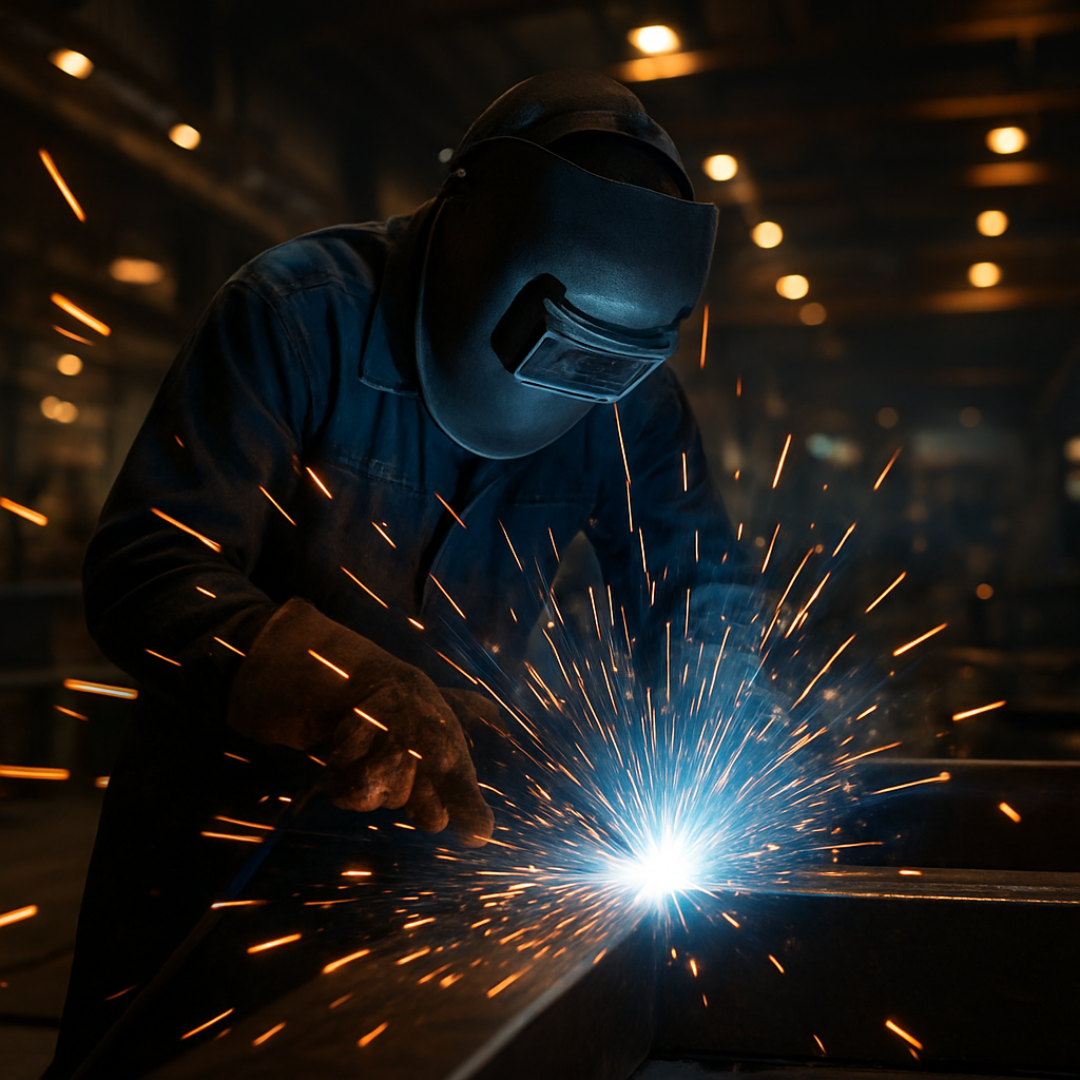
Arc welding is a metal joining process that uses an electric arc to generate intense heat, enough to melt and fuse metals together. The arc forms between an electrode and the base metal, creating temperatures of up to 6,500°F. Once cooled, the molten metal solidifies into a strong, permanent metallurgical bond.
Simple in principle yet powerful in execution, arc welding remains one of the most widely used fabrication methods in workshops, construction sites, shipyards, and repair environments. Whether manual, semi-automatic, or fully automated, all arc welding processes rely on electricity, heat, and controlled fusion to produce durable joints.

How Arc Welding Works
Arc welding is a fusion welding process, meaning it joins metals by melting them together rather than using adhesives or mechanical fasteners. A power supply delivers either direct current (DC) or alternating current (AC) through an electrode. When the electrode touches and then slightly lifts from the base metal, an electric arc forms in the gap.
The arc produces intense heat that melts the base metal and, in the case of consumable electrodes, the electrode itself. The molten metal forms a weld pool, which solidifies upon cooling to create a strong metallurgical bond. To prevent oxidation and contamination, a shielding mechanism, either gas, flux, or a combination, is used to protect the weld pool from air.
Types of Arc Welding
Arc welding processes are divided into consumable and non-consumable electrode methods.
Consumable Electrode Methods
Consumable electrodes serve two purposes: conducting electricity and supplying filler metal to the weld. Common methods include:
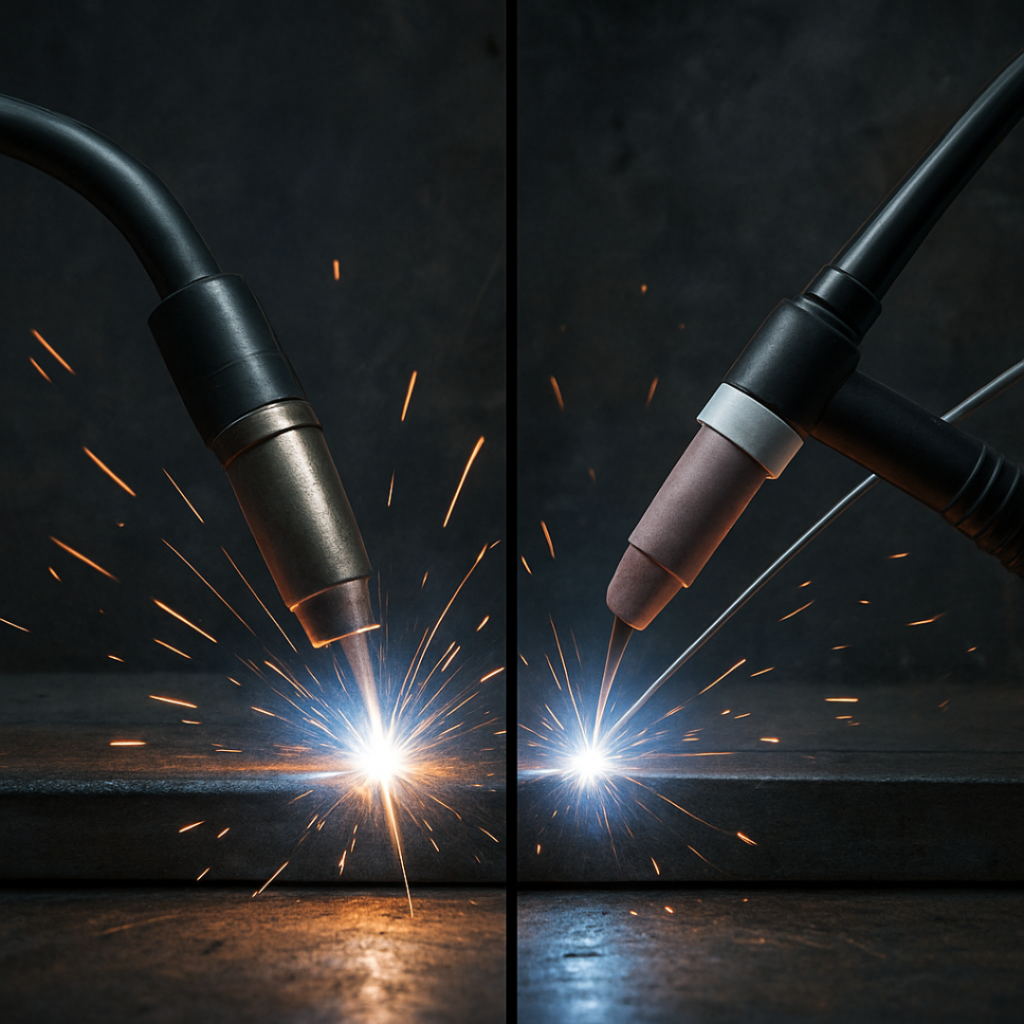
- MIG (Metal Inert Gas) / GMAW: Uses a continuously fed wire and inert gas for protection. Fast and ideal for thin metals like aluminum.
- MAG (Metal Active Gas): Similar to MIG but uses active gases, mainly for steel.
- SMAW (Shielded Metal Arc Welding): Also known as stick welding. The flux-coated electrode generates gas and slag to shield the weld.
- FCAW (Flux Cored Arc Welding): Uses a flux-cored electrode, sometimes with additional shielding gas, for consistent arc length.
- SAW (Submerged Arc Welding): Employs a flux blanket over the weld, reducing spatter and fume exposure.
- ESW (Electro-Slag Welding): Used for thick vertical plates, relying on molten slag resistance for heat.
- Arc Stud Welding: Efficiently joins fasteners or studs to a metal surface.
Non-Consumable Electrode Methods
These methods use electrodes that do not melt during welding.
- TIG (Tungsten Inert Gas / GTAW): Uses a tungsten electrode, with a separate filler rod if needed. Produces precise, clean welds.
- PAW (Plasma Arc Welding): Similar to TIG but uses a water-cooled plasma torch for higher energy density and deeper penetration.
Arc Welding Process Comparison
To better understand how these methods differ, here’s a practical side-by-side comparison:
| Process | Electrode Type | Shielding Method | Best For | Skill Level |
| SMAW (Stick) | Consumable (flux-coated rod) | Flux creates gas & slag | Outdoor work, structural steel, repairs | Beginner to Intermediate |
| MIG (GMAW) | Consumable (solid wire) | External shielding gas | Thin metals, fabrication shops, automotive | Beginner |
| FCAW | Consumable (flux-cored wire) | Flux core ± gas | Heavy steel, construction | Intermediate |
| TIG (GTAW) | Non-consumable (tungsten) | Inert shielding gas | Precision work, stainless steel, aluminum | Advanced |
| SAW | Consumable (wire) | Granular flux blanket | Thick plates, industrial production | Advanced / Automated |
| PAW | Non-consumable (tungsten/plasma) | Plasma + shielding gas | Aerospace and high-precision industrial welding | Advanced |
This comparison helps fabricators choose the right process based on material type, job environment, and skill level.
Direct Current (DC) vs Alternating Current (AC)
Arc welding can operate on DC or AC, each with advantages depending on the material and application.
- DC: Provides a smooth, stable arc with less spatter. Ideal for steel, stainless steel, and stick welding.
- AC: Electrons change direction continuously, which can help reduce arc blow. Commonly used for aluminum or magnetized metals.
| Feature | DC Welding | AC Welding |
| Arc Stability | Very stable | Moderate |
| Spatter | Low | Slightly higher |
| Penetration Control | Excellent | Moderate |
| Equipment Cost | Moderate | Often lower |
| Ideal For | Steel, stainless steel, pipe welding | Aluminum, magnetized materials |
Understanding SMAW (Stick Welding)
Stick welding is one of the most accessible forms of arc welding. It’s ideal for field work and repairs, providing strong joints on various metals. SMAW uses a flux-coated electrode, which melts to create both filler material and protective gas and slag.
Basic SMAW Workflow:
- Safety First: Wear a welding helmet, gloves, and fire-resistant clothing. Ensure ventilation.
- Setup: Connect the welding machine to the power supply, attach the ground clamp, and insert the electrode.
- Surface Prep: Clean metal surfaces to remove oil or rust and align workpieces.
- Strike the Arc: Tap or drag the electrode to initiate the arc.
- Maintain Arc: Keep the arc length roughly equal to the electrode diameter.
- Control Travel Speed: Move steadily and maintain proper angle.
- Remove Slag: After cooling, chip away slag and inspect the bead.

Advantages of Arc Welding
- Versatile: Works on steel, stainless steel, cast iron, and nickel alloys.
- Portable: Especially SMAW, suitable for outdoor or remote jobs.
- Durable: Produces strong, long-lasting joints.
- Cost-effective: Equipment is generally affordable compared to other methods.
Limitations
- Slower than automated processes
- Produces fumes and smoke
- Requires slag removal
- Challenging for thin metals
- Learning curve for beginners
Practical Applications
Arc welding remains essential in:
- Construction & Infrastructure: Buildings, bridges, and heavy steel structures.
- Shipbuilding: Creating watertight, durable joints in ships.
- Automotive Fabrication: Frames, exhaust systems, and repairs.
- Pipeline Construction: Oil, gas, and water pipelines.
- Mechanical and Manufacturing Industries: Machinery, HVAC systems, and industrial equipment.
Key Considerations
While arc welding encompasses several methods, understanding the right electrode, current type, and technique ensures strong, reliable welds. For example, MIG welding is fast and automated, ideal for thinner metals, whereas TIG welding offers high precision for intricate work. Stick welding (SMAW) provides durability and flexibility for outdoor and structural applications.
Even though the process produces fumes, smoke, and requires slag removal, proper safety measures and practice can overcome these challenges. Over time, welders develop consistency, accuracy, and efficiency in their technique.
FAQs
Is arc welding the same as MIG?
No. MIG welding is a type of arc welding. Arc welding is the broader category that includes MIG, TIG, stick welding, and more.
What is arc welding vs stick welding?
Arc welding refers to all welding methods that use an electric arc. Stick welding (SMAW) is a specific arc welding process using a flux-coated consumable electrode.
Is arc welding AC or DC?
It can be either, depending on the equipment, electrode, and material being welded. DC is often preferred for steel, while AC is used for aluminum and magnetized metals.
What is the disadvantage of arc welding?
Arc welding produces fumes and slag, requires skill to maintain consistent welds, is slower than some automated methods, and is less suitable for very thin materials.
Is arc welding permanent?
Yes. Arc welding creates a permanent metallurgical bond between metals once the weld pool cools and solidifies.
