Key Takeaways
- Spray transfer is one of four MIG (GMAW) metal transfer modes — it operates at high current and voltage above a threshold called the transition current, causing fine droplets to be axially propelled from the wire tip into the weld pool without the wire ever touching the base metal.
- Spray transfer produces virtually no spatter, a smooth hissing arc sound, high deposition rates, and excellent penetration on material 1/8″ and thicker.
- The main disadvantage is positional limitation — the large, fluid weld pool spray transfer creates can’t be supported by surface tension in vertical or overhead positions, restricting it to flat and horizontal work.
- Achieving spray transfer requires argon-rich shielding gas (at least 75–80% argon) — standard CO2 or CO2-heavy mixes won’t produce stable spray transfer regardless of how high you set the amperage.
- TIG welding remains the hardest common process to learn; spray transfer is a more demanding MIG mode than short-circuit but is not a separate “hardest welding” category on its own.
What Is the Spray Welding Process?
Spray transfer is one of four metal transfer modes in MIG (GMAW) welding — a mode where fine droplets of molten metal are pinched off the wire tip by electromagnetic forces and propelled axially through the arc into the weld pool, without the wire ever making contact with the base metal. The “spray” name describes exactly what’s happening: rather than the wire touching and shorting (short-circuit transfer) or large irregular globs falling across the arc (globular transfer), tiny, consistently sized droplets stream continuously and rapidly across the arc in a directed spray.
This transfer mode is triggered by exceeding a threshold called the transition current — a specific amperage level that depends on wire diameter, wire type, and shielding gas composition. Below this threshold, MIG welding operates in globular or short-circuit mode; above it, the electromagnetic pinch effect takes over and produces true spray transfer.
The Four MIG Transfer Modes Compared
Understanding spray transfer requires placing it in context alongside the other three modes:
Short-Circuit Transfer — the wire touches the base metal 90–200 times per second, shorting the circuit and depositing metal through contact. Lowest heat input, best for thin material and out-of-position welding, operates at 50–150A.
Globular Transfer — operates between short-circuit and spray thresholds. Large, irregular droplets larger than the wire diameter cross the arc inconsistently, producing spatter. Rarely the preferred mode — it’s what happens when settings are between the two more desirable modes.
Spray Transfer — above the transition current, fine droplets stream axially without wire-to-base contact. No spatter, hissing sound, high deposition, flat and horizontal position only.
Pulsed Spray Transfer — alternates rapidly between a high peak current (achieving spray transfer) and a lower background current (below the transition threshold), allowing spray transfer characteristics with lower average heat input. The pulsed mode extends spray transfer’s applicability to thinner material and out-of-position work that standard spray transfer can’t handle.
What Is the Main Disadvantage of Spray Transfer?
The primary limitation of spray transfer is positional restriction — the high amperage and heat input required to sustain it produces a large, highly fluid weld pool that can’t be supported by surface tension when working against gravity. This limits standard spray transfer almost entirely to flat (1G) and horizontal (2H/2F) positions. Attempting spray transfer in vertical-up, vertical-down, or overhead positions typically produces the weld pool dripping or running out of the joint before it can solidify.
This is a significant practical constraint — many real-world fabrication joints require positional welding, forcing welders to switch to short-circuit or flux-core processes for out-of-position work even on material thickness where spray transfer’s penetration and deposition would otherwise be ideal.
Additional disadvantages worth understanding:
Requires argon-rich shielding gas — spray transfer only occurs reliably with 75–80% argon or higher. Standard CO2 or C25 (75% argon/25% CO2) is at the edge of producing true spray; 90–98% argon or argon-oxygen blends are more commonly specified for reliable spray transfer. This higher-argon gas is more expensive than CO2-heavy blends.
Higher minimum amperage requirement — the transition current threshold varies by wire diameter and type, but typically starts around 170–200A for .035″ steel wire. This means spray transfer requires a more powerful machine than short-circuit welding.
Risk of burn-through on thinner material — the high heat input that comes with spray transfer’s current levels can cause burn-through on material under 1/8″ without the control pulsed spray transfer adds.
Is Spray Welding Difficult?
Spray transfer is more demanding to set up correctly than short-circuit MIG but isn’t a fundamentally more difficult physical skill once the parameters are dialed in. The main challenge is understanding the conditions required to produce and maintain true spray transfer — the right shielding gas, above the transition current threshold, and within the appropriate voltage range — because the mode either works or it doesn’t, without much middle ground.
Once established, the spray arc itself is more forgiving in some ways than short-circuit work — the hissing, stable arc with no spatter is easier to maintain and read than short-circuit’s more reactive arc, and the smooth fluid puddle moves predictably at the right travel speed.
The difficulty comes at the setup stage and when something goes wrong: if shielding gas runs low, if amperage drops below the transition current, or if voltage is set incorrectly for the wire speed, the arc reverts to globular transfer — a spattery, inconsistent mode that welders sometimes mistake for their technique being wrong when it’s actually a parameter issue.
How to Set Up Spray Transfer: Step-by-Step
- Confirm your shielding gas mix. You need at least 75% argon, with 90%+ argon or an argon-oxygen blend producing more reliable results. Standard C25 (75/25 argon-CO2) sits at the edge; straight CO2 won’t produce spray transfer.
- Select a wire diameter appropriate to your material. Spray transfer works best on material 1/8″ and thicker; .035″ or .045″ wire are common choices.
- Set amperage above the transition current threshold. For .035″ mild steel wire, this is typically around 180–200A as a starting point.
- Adjust voltage to produce a stable hissing arc. Spray transfer’s characteristic sound is a smooth, quiet hiss rather than the popping of short-circuit or the crackle of globular. Voltage too low collapses back toward globular; voltage too high produces a long, wandering arc.
- Confirm position before welding. Flat and horizontal only — if the joint requires another position, switch to short-circuit or flux-core rather than trying to force spray transfer.
Spray Transfer vs Thermal Spray Welding
It’s worth clarifying a terminology distinction that causes genuine confusion: the term “spray welding” can refer to two very different processes depending on context.
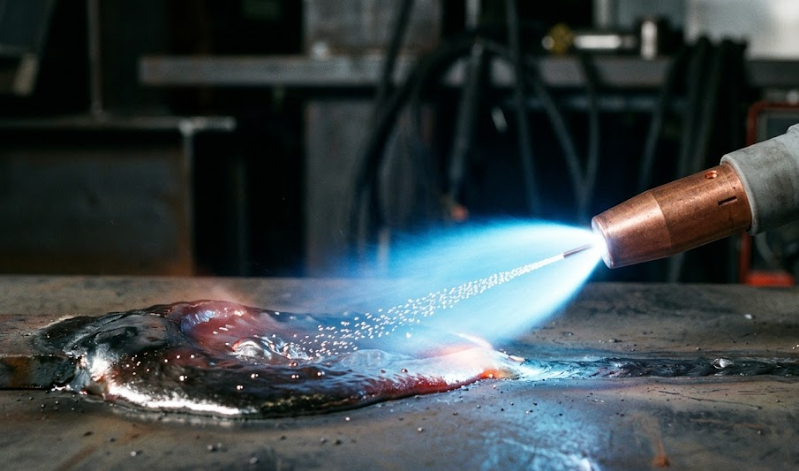
Spray transfer welding (this article’s subject) is a MIG/GMAW metal transfer mode — it’s the mechanism by which molten metal crosses from the wire to the base material in a standard GMAW setup.
Thermal spray welding (also called flame spray welding or HVOF) is a completely separate process where metallic or ceramic powder or wire is melted and propelled onto a substrate surface using a flame, plasma, or gas jet — primarily used for surface coating, wear protection, and corrosion resistance rather than structural joining. It doesn’t create a fused weld joint in the conventional sense.
If your interest is in surface coating rather than structural welding, thermal spray is a separate field with its own equipment, materials, and certification requirements entirely distinct from GMAW transfer mode selection.
What Is the Hardest Welding to Learn?
TIG welding (GTAW) is consistently regarded as the hardest common welding process to master, requiring simultaneous coordination of a torch in one hand, a filler rod in the other, and foot pedal heat control — all with very little margin for error on each variable. Spray transfer MIG is a more demanding mode than short-circuit to set up and troubleshoot, but it’s still a MIG process at its core, not a separate category of difficulty.
If hardest is measured by physical coordination demands and technique sensitivity rather than setup complexity, TIG remains the standard answer across nearly every independent source in the industry.
Common Mistakes With Spray Transfer
- Using the wrong shielding gas — attempting spray transfer with CO2-heavy blends produces globular transfer regardless of amperage, which is often diagnosed as a technique problem when it’s actually a gas selection issue.
- Staying below the transition current — setting amperage conservatively and expecting spray transfer to occur produces globular transfer, not spray. Above the threshold is a requirement, not a guideline.
- Attempting out-of-position welds — spray transfer’s fluid puddle runs out of vertical and overhead joints; switching to short-circuit, flux-core, or pulsed spray is the right response, not trying to fight the puddle.
- Confusing the two meanings of “spray welding” — thermal spray coating and spray transfer MIG welding are unrelated processes; equipment, materials, and certifications don’t transfer between them.
- Treating voltage and wire speed as independent settings — spray transfer has a narrower stable operating window than short-circuit; changes to one variable need corresponding adjustment of the other to stay within the spray mode rather than dropping into globular.
Wrapping Up
Spray transfer welding earns its place in a fabrication toolkit for flat and horizontal work on material 1/8″ and thicker, where its combination of no spatter, high deposition rate, and deep penetration outperforms short-circuit and globular transfer. The practical constraints — positional restriction, argon-rich gas requirement, and a minimum amperage threshold — define exactly when to use it and when to reach for a different process instead.
Frequently Asked Questions
What is the process of spray welding?
Spray transfer is a MIG (GMAW) metal transfer mode where fine droplets are pinched from the wire tip by electromagnetic forces and propelled axially through the arc into the weld pool without wire-to-base contact. It produces no spatter, a characteristic hissing arc sound, high deposition rates, and excellent penetration on material 1/8″ and thicker — but only in flat and horizontal positions.
Why do welders drink milk after welding?
This traces back to a long-standing shop myth tied to metal fume fever from welding galvanized steel. There’s no solid medical evidence that milk prevents or treats metal fume fever — proper ventilation and a respirator are the actual solution.
What is the main disadvantage of spray transfer?
The primary limitation is positional restriction — the large, fluid weld pool spray transfer produces can’t be supported by surface tension against gravity, limiting it to flat and horizontal positions and making it impractical for vertical or overhead work.
Is spray welding difficult?
The physical technique is more straightforward than TIG welding once parameters are correctly established, but spray transfer requires understanding and controlling the specific gas, amperage, and voltage conditions that trigger the transfer mode — getting these wrong produces globular transfer rather than spray, which is sometimes mistaken for a technique problem.
What is the hardest welding to learn?
TIG welding is consistently regarded as the hardest common process, requiring simultaneous coordination of torch, filler rod, and foot pedal with very little margin for error. Spray transfer MIG is a more demanding setup than short-circuit but remains a MIG process rather than a separate difficulty category.